What Is the Definition of Clay What Is the Definition of Clincher in Laungugage Arts
Language Arts in My Household


At its nigh basic level, language arts is well-nigh advice: taking in information and sharing information with others. Sounds simple, right?
So why is language arts such a difficult subject to programme and teach?
One large reason that language arts can be difficult is that the single subject area of "linguistic communication arts" actually encompasses more than 10 related topics: phonics, reading, handwriting, listening skills, spelling, grammar, writing, poesy, literature, vocabulary, and speech! It doesn't seem quite and then simple anymore, does it?
Many homeschool parents long for an all-in-ane language arts curriculum, merely an inclusive approach to teaching language arts can be hard. About kids larn to read faster than they learn to write or spell, and then although an all-in-i program might exist just right for reading, it may be too advanced for writing. For another child, a program may be perfect for spelling only too wearisome for reading.
Putting It All Together
Would you like to hear how a seasoned homeschooler makes linguistic communication arts work in her household? Merry Marinello homeschooled ii children of her own, and then her language arts expertise comes from years of experience in the trenches, figuring out exactly how to teach this multifaceted subject to her kids. As office of our customer service team, Merry has also responded to thousands of questions from parents virtually using All About Reading and All Almost Spelling with their children.
Here's Merry…
When I realized that an all-in-one curriculum only wasn't a feasible option for my children and that I would have to become another management, I knew I had to brainstorm by identifying what my goals were. I started by asking myself a few important questions:
- Why do I teach linguistic communication arts?
- What am I trying to attain?
- In what order should I teach the skills that brand upwardly "language arts"?
- And finally, what priority should I requite them?
Later on considering my answers to these questions, I worked out a progression for teaching language arts that looked like this:
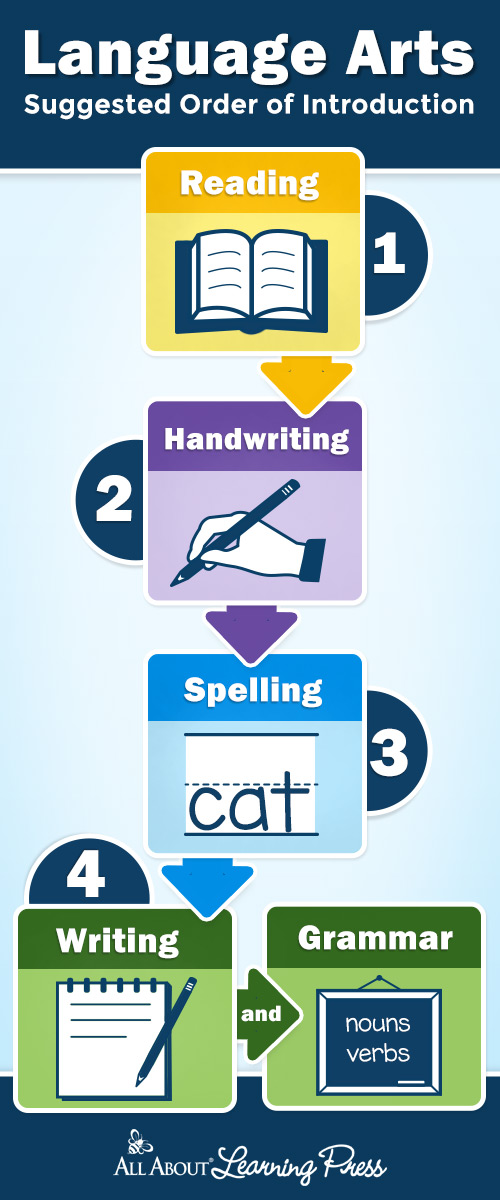
I knew that just figuring out a logical sequence for teaching language arts wasn't enough. I notwithstanding had to effigy out how to fit all those content areas into our school mean solar day and use some time limits for daily education. I like to do xxx to lx minutes of daily language arts teaching for kindergarten and first form, and 60 to 90 minutes each day for second grade and up.
Language Arts: Start with the Basics
Sticking to these time limits requires some prioritizing. Here'southward how I concluded up fitting it all in—but keep in mind that these recommendations are what worked for my children. You may need to increase or decrease your didactics time depending on your kid's attention span, abilities, and progress.
A basic beginning plan for kindergarten or first grade might starting time similar this:
- Phonics and reading teaching:
xx to xxx minutes per day - Handwriting instruction:
10 minutes per twenty-four hours
A Notation nigh Handwriting
When just starting out, handwriting doesn't have to involve putting pen to paper. Instead, yous and your child tin do things like writing with an alphabetize finger in sand or in pudding or on carpet squares or whatever other tactile surface. Writing is fairly complex and involves both gross and fine motor muscle tone likewise as neurological interest and working memory. I think thinking that pre-writing types of activities weren't all that important when, in fact, they are very important. I was too anxious to go to "the real thing" (pencil to newspaper). If I had it to exercise over again, I'd spend more time doing fun pre-writing activities.
Add in the Rest
When a child becomes fluent in reading simple words, it'south fourth dimension to add in:
- Spelling instruction:
20 minutes per twenty-four hour periodAnd…when a child tin read chapter books fluently, your phonics and reading didactics time tin transition to:
Silent reading:
30 minutes per day
A Note about Read-alouds
There are lots of great reasons to read aloud to your children. I recommend reading aloud to even your older children for a minimum of 20 to 30 minutes each day. Read-alouds teach many valuable language arts skills, such as vocabulary. I often end to see if my kids know a word, or they will stop me and ask for a definition. Syntax and grammar and the flow of our language are also taught informally. Poesy can teach rhyming, ingemination, and the musicality of linguistic communication. You lot can work on listening skills and comprehension by asking simple questions like "What exercise y'all think will happen next?" or "Why do yous think the character did that? Would you accept done that?" Most of all, reading aloud can help your child develop a lifelong love of learning. I nonetheless read to my high school and junior loftier students, and I will continue every bit long equally I can become away with it!
When your child is ready for more, you tin begin to add in writing and grammer.
- Writing and/or grammar didactics:
xxx minutes per day
I started off by working on these topics informally. I institute it easier to add together a formal writing program after my children could spell around a thousand words. Writing and grammar practice not take to be taught simultaneously. In that location are many ways to customize instruction in these areas. You tin can cull to focus on i per year, or do them on alternating days. Endeavour breaking instruction up into 6-, 9-, 12-, or eighteen-week segments, or use a program that incorporates both content areas.
With older children, speech can be woven into the writing/grammar time slot besides.
Recollect, y'all don't have to do every linguistic communication arts topic every yr. The virtually important thing is to think through your goals, consider the individual needs of each child, and build your linguistic communication arts program footstep by step.
Practise yous have a arrangement for teaching language arts that works for your family? How is it different from this system? Let us know in the comments!
guimondhathapasse86.blogspot.com
Source: https://blog.allaboutlearningpress.com/language-arts-in-my-household/
0 Response to "What Is the Definition of Clay What Is the Definition of Clincher in Laungugage Arts"
Post a Comment