When Can We Bomb Japan Again
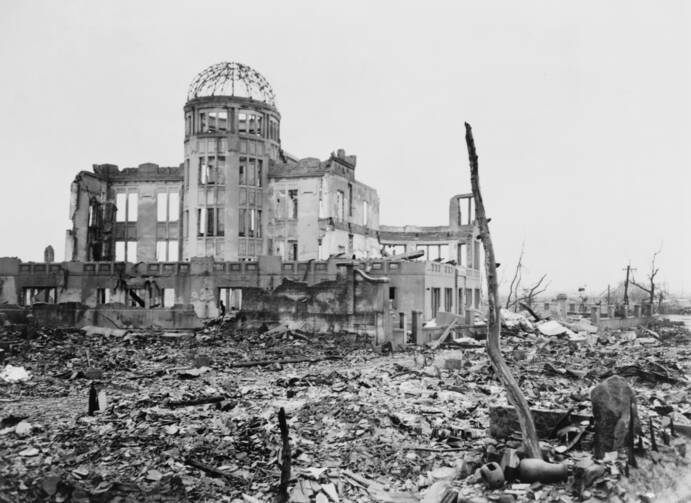
A newsboy shouting "Actress! Extra" came around flashing the headline "New Flop Destroys Hiroshima." It was August 6, 1945. Nosotros, a grouping of young Marines in the Navy Linguistic communication School on the campus of Oklahoma A&M, were taking a short morning break from our intensive Japanese training to go "gainsay interpreters." Going back to class with our Japanese-American teachers, we knew that some of them had relatives living in the Hiroshima surface area, but we could not ask them. A few days afterward, a letter came from a Jesuit I knew from university, "I told the students at the morning time Mass, 'With this bomb, America lost the war.'"
The side by side yr I entered the Jesuits, and after was missioned to Nihon. Over the by 70 years I have tried to larn as much equally I could about how the state of war with Japan had begun and especially how it ended—when and why the United States lost the moral high basis by engaging in indiscriminate mass bombing of civilians, culminating in the dropping of atomic bombs on Hiroshima and Nagasaki.
Concluding year, U.Southward. Ambassador Caroline Kennedy (the daughter of John F. Kennedy) visited Nagasaki. On that occasion, an association of citizen groups for the abolitionism of nuclear weapons published in The Japan Times (Feb. 6, 2014) an open up letter of the alphabet to President Obama:
We urge y'all .... to acknowledge that the atomic bombing of Hiroshima and Nagasaki in August 1945 was a crime confronting humanity involving indiscriminate mass killing of civilians. Accordingly, we urge you to offer an official apology to the victims of these state of war atrocities. We are convinced that an American amends is vital to attain the abolishment of nuclear weapons. Nosotros as well sincerely believe that doing and so will increase force per unit area on the Japanese authorities to acknowledge its own war crimes of the 1940s.
The letter of the alphabet goes on to enumerate in detail many of the Japanese state of war crimes, and assert that Japanese leaders, beginning with the Emperor, diverted attention from their own war crimes past assuming the role of victim of the atomic bombing. (For more on the question of a U.South. apology, run across the postscript below.)
Night Raids
In early 1945, once the Japanese had been driven out of the Pacific islands of Saipan, Tinian and Guam, the Air Force mounted a bombing campaign against the Japanese dwelling house islands. Soon, however, the strategy shifted from high-level bombing to mass low-level night raids dropping twirling metal racks that threw out called-for blobs of napalm. The first large-scale raid on the windy night of March 9, 1945, burnt up a large densely populated area of central Tokyo. An estimated 86,000 people were incinerated. That was the kicking-off of a entrada that, by Baronial of 1945, had already gutted over sixty city centers. Alert leaflets were now being dropped off a few days ahead of the attacks then that people could attempt to escape the target cities.
For the atomic bombs, a "Target Committee" under General Leslie Groves, head of the Manhattan Project, discussed how to use the bombs for the maximum stupor consequence. This group morphed into the "Interim Committee" of government, armed services and scientific members advising President Harry Truman on the use of the atomic bomb. They recommended dropping ii bombs. The first was to exist on Hiroshima, a city selected, not for its military machine importance, just because it was a broad flat area. In the city there was an army divisional headquarters, but no big state of war production factories within the target area—only a broad expanse of homes, schools, hospitals, shopping and city administration areas. The parachuted bomb was ignited 1,500 feet higher up the city—a summit carefully calculated for maximum destructive upshot. The Air Force had to be explicitly notified to "spare" Hiroshima from its fire-bombing campaign.
What could have morally justified killing 140,000 people, most of whom were civilians? The historical record shows that the decision to use the atomic bombs was effectively made in early June when President Truman agreeably received the recommendations of the Interim Committee from Secretary of War Henry L. Stimson. The official written armed forces order, finer pulling the trigger, was sent out on July 25, the day before, not after, the Allies issued the Potsdam Proclamation, which set terms of surrender for Japan. After the war, President Truman asserted that he decided to drop the atomic bomb after Japan failed to respond to the terms laid out in the proclamation.
President Truman, together with Secretary Stimson, in the years right after the war, was the source of the "myth" that killing 140,000 people in Hiroshima and lxx,000 more in Nagasaki saved "a one thousand thousand casualties on both sides" if it should take come to a mass invasion and a drastic fight to the finish on the home islands of Japan. Historians and military experts have repeatedly disputed these numbers, making an judge of a maximum of 46,000 deaths in the event of a total invasion. Such estimates likewise as war machine planning, of class, had to presume the worst, namely that no adequate terms of surrender would be offered, only "unconditional surrender."
Moreover, we know now that among the tiptop armed services officers at the fourth dimension, most foresaw that the Japanese would probable have to capitulate inside a few months without demand for an invasion. Admiral William D. Leahy, chairman of the Joint Chiefs of Staff, wrote in 1950: "It is my opinion that the use of this brutal weapon at Hiroshima and Nagasaki was of no material assistance in our war confronting Nippon. The Japanese were already defeated and gear up to surrender…" The Japanese Navy had been destroyed; the home islands were already blockaded by submarines and shipping carriers. Aircraft for essential oil imports, steel, and even for food had been cutting off. Oil refineries and storage had been systematically bombed by B-29'southward from Guam. Even if the horrendous supposition of President Truman were truthful, was information technology morally permissible to cede 210,000 hostages with the A-Bomb in order to force Nihon to surrender?
Fifty-fifty if the horrendous supposition of President Truman were true, was information technology morally permissible to sacrifice 210,000 hostages with the A-Flop in order to force Japan to surrender?
Many officers of the Japanese Regular army, especially those of middle-rank, were fight-to-the finish fanatics. But there were reasonable men among Japan's military and political leaders. In summer of 1945, the Japanese government, then not at war with Russia, was trying through their administrator and the Emperor'southward special envoy in Moscow to persuade the Soviets to arrange negotiations for ending the state of war. Stalin and Molotov, withal, duplicitously stalled the talks while rapidly moving their armies across Siberia to assault Japan. The U.Due south. government knew the intentions of the Soviets, for Stalin had bodacious Roosevelt already at Yalta (Feb. 1945) that the Soviets would attack Nihon 3 months subsequently the defeat of Germany (May 1945). The U.S. regime, having broken the Japanese diplomatic code, was listening in on what they knew were feckless Japanese diplomatic efforts in Moscow. Is it naïve to ask why the U.S. government in the early summer of 1945 did not endeavour to meet the Japanese in their efforts to negotiate a give up? At that place were neutral countries such as Switzerland, Sweden or the Vatican that could accept acted as become-between.
Proposals to Cease the War
By July 1945, proposals had been developed within the U.S. government to make information technology easier for the Japanese leaders to end the war. These proposals suggested dropping the blunt demand for "unconditional surrender" and offer more detailed conditions, namely that the armed forces surrender unconditionally and that all war potential exist destroyed, while a autonomous national polity with the Emperor as head of state could be retained. Such a proposal could, information technology was hoped, be a ground for negotiating an before surrender. But President Truman did not act on these recommendations. The Allied leaders Potsdam Proclamation (July 26) broadcast as a kind of ultimatum, omitted the proposed assurance that the Japanese would be "costless to choose their ain form of authorities." With this omission the hardliners could come across the Proclamation to be picayune different from "unconditional surrender." The Japanese government delayed its response, still striving in vain—and open to U.Southward. intelligence—to negotiate for meliorate conditions through the Soviets.
Would a virtual history in which the Japanese would have earlier been shown assurances that the royal system could exist maintained take led to an earlier end of the war? We don't know, but it would have been a more humane attempt. If negotiation could have concluded the war sooner, there would have been no temptation to drop the atomic bomb; the war could have ended before the Soviets could declare war and invade Japanese occupied Manchuria and Korea. Today, there might exist only one Korea.
Whether ane agrees or not with this projection of virtual history, the judgment remains that the U.S. leaders did non attempt more than effective diplomatic efforts to bring the war to an earlier and more than humane end, and that the bombing of Japan, culminating in the apply of atomic bombs, was the apply of immorally excessive force—and on predominantly civilian populations. Practise we dare call it a state of war criminal offense?
If negotiation could have ended the war sooner, at that place would have been no temptation to drop the atomic bomb; the state of war could have ended earlier the Soviets could declare war and invade Japanese occupied Manchuria and Korea. Today, at that place might be only 1 Korea.
Postscript: Is an Amends Called For?
Immediately afterwards the dropping of the two atomic bombs, and earlier the actual surrender, the Japanese Foreign Minister sent a telling protestation through the Swiss government:
It is the fundamental principle of international law in wartime that belligerents practise not posses unlimited rights regarding the choice of the means of harming the enemy, and ….must not employ arms, projectiles or material calculated to cause unnecessary suffering. (Hague Conventions). The indiscriminateness and cruelty of the bomb the U.S. used this fourth dimension far exceed those of poisonous gases and similar weapons, the utilize of which is prohibited because of these very qualities….The use of such a weapon is a new crime against human culture.
This was the starting time and only protest letter the Japanese government always issued on the atomic bombings.
Less than a week afterward, on Baronial 15, 1945 Emperor Hirohito broadcast his Imperial Rescript on the Termination of the War. He gave equally reason for accepting the Allies' atmospheric condition:
The enemy has begun to employ a new and cruel bomb with incalculable ability to damage and destroy many innocent lives. If nosotros keep to fight, information technology would lead not simply to the ultimate plummet and obliteration of the Japanese nation, merely it would also lead to the total extinction of human being culture.
Japan, then, becomes the victim to save "human civilization." In the Rescript, the Emperor, in the aforementioned vein, expressed concern for "our allied nations of East Asia, who accept consistently cooperated with the Empire toward the emancipation of Eastern asia." At the end of the war, almost people of Eastern asia would have preferred not to be "emancipated" in that way.
Later, in 1955, v victims of the Hiroshima atomic bomb sued the Japanese authorities for damages. The Japanese regime then reversed its position on the criminality of the bomb:
The use of the atomic bomb hastened Japan's give up and consequently prevented belligerents on both sides from being injured or killed…Examined objectively no 1 can conclude whether or not the atomic bombings…violated international law. Moreover, given that an international agreement to ban the use of nuclear weapons is yet to be formulated, we recall that it is not possible to hastily define it illegal…From the viewpoint of international law, war is fundamentally a situation in which a country is allowed to exercise all means deemed necessary to cause the enemy to surrender.
Given this opinion of the Japanese regime, the writers of the letter of the alphabet to President Obama believe that a straightforward apology and recognition that the dropping of the diminutive bombs were a state of war crime, would pressure the Japanese government to acknowledge its own state of war crimes. Simply now 70 years later, such an apology from the U.s. is unthinkable unless the people of the United States can be emancipated from the myth that the people of the 2 cities were vicariously sacrificed to the gods of war to avoid an even greater holocaust.

guimondhathapasse86.blogspot.com
Source: https://www.americamagazine.org/politics-society/2015/08/05/was-bombing-japan-only-option
0 Response to "When Can We Bomb Japan Again"
Post a Comment