Which Art Work Is an Example of an Assemblage? Brainly
At get-go glance, it could be said that assemblage is a three-dimensional alternative to collage – a technique of composing a work of art by pasting on a surface diverse materials non normally associated with one another (equally defined past an online dictionary). The term was first introduced to the art globe past the "outsider" artist Jean Dubuffet in the 1950s, but there were lots of examples of this technique earlier in the past, some of which are quite easy to recognize, and some lie hidden beneath the veil of history. These include early works past Pablo Picasso and other representatives of Cubism, whose approach to assembling goes across the surface of an epitome, or the volume of a body, since the entire philosophy of cubism relies on fragmentation. Nevertheless, the genesis of assemblage owes a lot to the introduction of a prepare-made, which made it possible for everyday objects to participate in the creation of art projects, over again pointing to Marcel Duchamp, the male parent of art as we know it today. But what role does assemblage play at present, in the Post-Internet era? How can nosotros ascertain aggregation today?
Be certain to check out works by Jean Dubuffet on our marketplace!
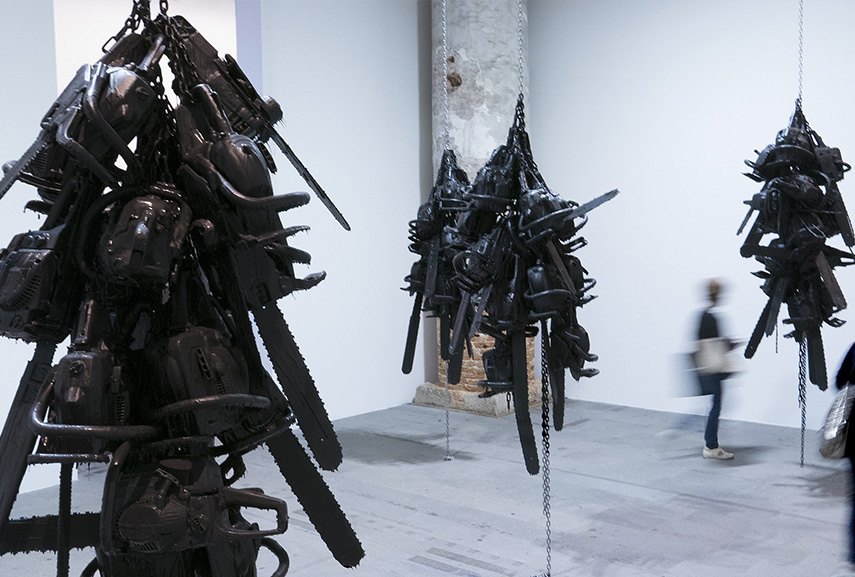
Assemblage - Definition
Assemblage is both the procedure and the product of art-making, referring to an human action of putting various fragments together, in lodge to compose a piece. Ever since the term was introduced, information technology had a slightly "grungy" feel to it, since the process ofttimes involved the utilise of discarded objects, found objects, remnants or scraps. However, the power to anticipate a composition made out of seemingly redundant or incompatible elements seems like a precious talent, which is not really grungy at all. These random objects come together in an inexplicable harmony, creating a coherent composite paradigm, while normally being quite meaningless individually. This essence of assemblages is reminiscent of syntax relations, analogous to syllables, words and sentences, which comes as a good opportunity to consider why assemblage is a term frequently used in linguistics equally well. In linguistics, an assemblage is "built primarily and explicitly from existing texts to solve a writing or communication problem in a new context". Contemporary philosophy deals with the term quite thoroughly, but we don't have to get that far to detect the analogy between a mix of "existing texts", and a mix of existing stuff, which is what assemblage in art could be.
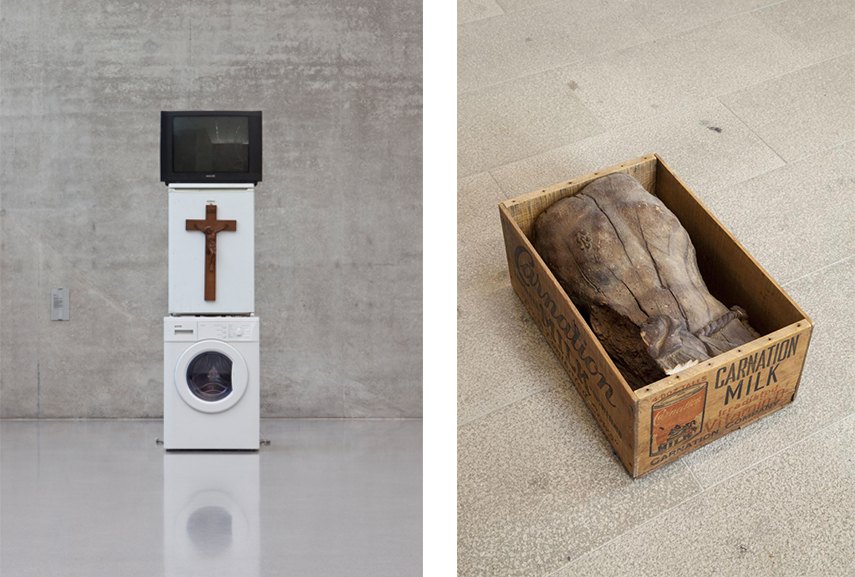
Linguistics Helps Usa Empathize Art
We could cull to detect this definition quite literally, and a line of historical examples helps the states exercise so (considering some of the defining works from the 2d half of the 20th century, such equally those of Joseph Cornell, Robert Rauschenberg, Jasper Johns, Mike Kelley, Meret Oppenheim). Fifty-fifty though most of today's art seems to linger somewhere in betwixt all the genres, the "classical" examples of aggregation in contemporary fine art nonetheless exist. Selected items are arranged into various spatial systems, some of which piece of work with the senses of a viewer on an abstract level, some seem to tell stories through their symbolic meaning, and some construct figurative images. We could go one step further with this, and consider assemblage the aforementioned fashion that linguists exercise, comparing it to the concept of a remix in music (which is something that has already been done past Nicholas Bourriaud in Mail service-Prodction). The moment assemblage stops existence reduced to the employ of discarded, meaningless fragments only, it becomes a type of appropriation. It adopts, or takes over the existing pieces, mayhap fifty-fifty some artworks, which often lose their original notion in the process, and acquire new meanings within the newly established contexts. This means that a lot of today's artworks, ones which are sometimes defendant of beingness abusive of the work of others, could exist regarded as forms of contemporary assemblage, or collage. If yous desire to find examples, you could get-go with Matty Mo (The Most Famous Artist) - although he, himself, refers to these artworks as "art objects". In addition, well-nigh of these contemporary art "remixes" are covered by the veil of the Internet, which makes near things more than accessible, merely somehow less personal.
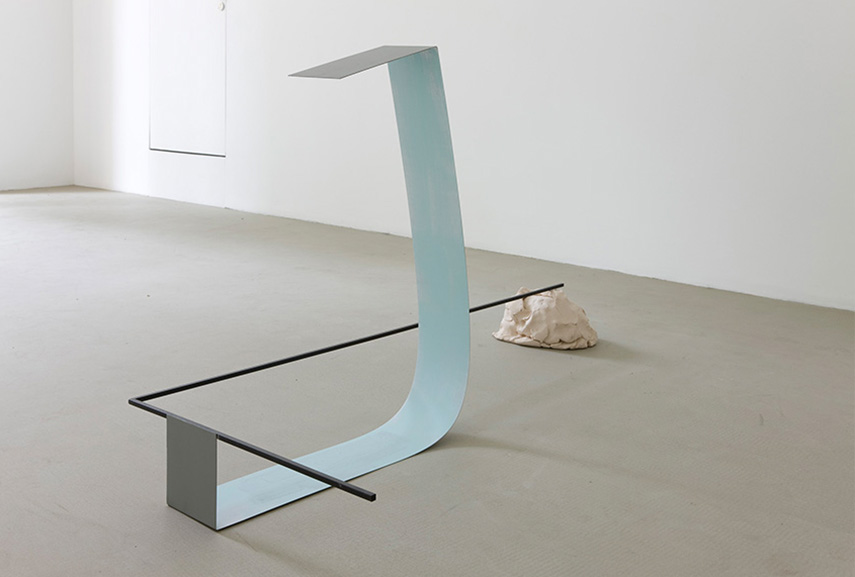
Aggregation vs. Sculpture
Whichever of the overlapping definitions we choose, assemblage could be understood through its relations to other mediums, and hence to itself. The distinction from collage should be articulate, but there is another medium likely to cause defoliation: How tin nosotros, actually, tell the difference between assemblage and sculpture today? Sculpture is no longer a medium constrained by what it used to exist hundreds and thousands of years agone (molding and etching), and assemblage is quite a young genre and then it did not have that much fourth dimension to evolve, but information technology is a somewhat vague category itself. Nevertheless, both of these art forms operate on a 3-dimensional level, less engaging than an art installation, more palpable than an image. Gimmicky art does not insist on strict categorization, but nosotros could endeavor to respond this question in gild to understand assemblage better. The difference could be establish in the way that the ii are defined, where sculpture seems to be a much broader category which could fifty-fifty include assemblage as a sub-medium today. Withal, on a merely intuitive basis, it looks like assemblages keep the quality of being fragmented even when rendered every bit a whole, meaning that they are, indeed, compounds, but they are characterized past a heterogeneous nature. With sculpture (in a narrower sense), the emphasis seems to be on the whole itself as a definitive unity, rather than on the way that it was made, and what information technology consists of. With this in mind, it becomes a bit easier to categorize the works of artists who place their art right between sculpture and assemblage, such as the metaphyiscal objects of Thea Djordjadze for instance, or those ofAlexandre da Cunha, Jumana Manna and Monica Bonvicini, each of whom have this capacity to create autonomous constellations which converse with the audition in a strange, fresh manner. More sculptures and more than assemblages, they seem to create parallel worlds.
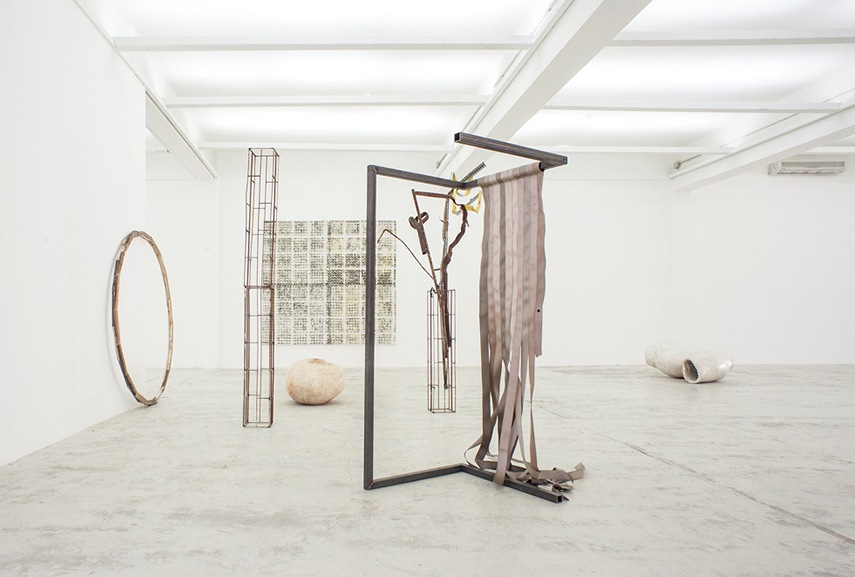
Globe Total of Gimmicky Examples
1 of the rising stars of the Danish art scene, Danh Vo, could be a very good representative of art based on the technique and the logic of assembling. The creative person of Vietnamese origin was described equally "an arranger of ruins and fragments", who "prefers to let the fragments speak for themselves" (Guardian). You volition find all kinds of objects among the "ruins" that his artworks resemble, often followed by words and titles that bring virtually new dialectic meanings. For Vo, the selection to work with theruins is quite personal, reflecting on his difficult by; but information technology is a perfect counterpart to contemporary assemblage. Another artist whose art regards one-time traumatic experience, Sara Rahbar, is however some other good example of an assembler. The listing of similarities between these two artists includes a reference to Jasper Johns and the remediation of the American flag. While you're at it, you should also consider the works of Pepo Salazar, whose piece of work for the last year's Venice Biennale was a huge "assemblagesque" immersive environs, a completely contained planet with a system of its own,perhaps fifty-fifty a potential successor of Beuys' social sculpture. These works show how the familiar objects, when taken out of their original surroundings, tend to keep some of their social connotations, but also drop the ones that practice non affair. This interaction with the viewer's own experience is a great example of what aggregation relies on.


"The Art of Assemblage" is a useful, instructive and inclusive review of the ground-breaking exhibitions at the Museum of Modern Art, October two - November 12, 1961, the Dallas Museum for Contemporary Arts, January 9 - February eleven, 1962, and the San Francisco Museum of Art, March 5 - April 15, 1962. Information technology explains the nature of assemblage, comparing information technology to the techniques of collage and introducing the relevant works of some important artists such as Picasso, Schwitters, Duchamp, De Kooning and many others.
Featured images: Pepo Salazar - The Subjects, role of the installation, Venice Biennale 2015; Meret Oppenheim - Object, 1936. All images used for illustrative purposes simply.
guimondhathapasse86.blogspot.com
Source: https://www.widewalls.ch/magazine/contemporary-assemblage-art
0 Response to "Which Art Work Is an Example of an Assemblage? Brainly"
Post a Comment